

The Importance of Business Value for Startup and Business Success

Business is fundamentally about creating value. According to Harvard Business School Online, regardless of a business’s size, industry, or model, its success depends on one thing: creating value for customers (Heinrich, 2026).

At its core, a business succeeds when it offers a product or service people want to buy at a price higher than the cost of production. Value creation is the process of turning raw materials, ideas, and resources into products or services which are worth more than the cost of making them. It involves solving problems, improving lives, and delivering solutions people want to pay for. By generating value for customers, employees, and stakeholders, a business builds long-term loyalty, drives innovation, and ensures sustainable financial success.

The Meaning of Value in Business

To understand value creation, we must understand what value is in business. Depending on the context, value is usually divided into three main categories: customer value, the financial worth of the business (for example, stock value), and perceived value, as discussed below.

Customer Value (The “What you give” vs. “What you get”)

This is the net benefit a customer receives in exchange for the price they pay. It is subjective and entirely determined by the buyer.

  • Utility. Does the product or service actually solve a problem or make the customer’s life easier?
  • Value proposition.  This is the unique mix of features, price, and experience a company offers to make its products more appealing than competitors’.
  • Added value. The difference between the cost of making a product and the price a customer is willing to pay. For instance, offering a warranty or 24/7 customer support adds value.

    Why Customers Drive Value Creation

    Among a business’s stakeholders, customers are most important in the value-creation process. Customers are the ultimate source of revenue and the reason a business exists, meaning all other value created for stakeholders depends entirely on whether a customer is willing to pay for a product or service.

    • The source of revenue. Customers provide the financial capital through purchases that turn into revenue, profit, and returns for shareholders.
    • Value co-creation. Modern business views value not as something a company delivers, but as a joint process in which customer feedback, usage, and co-creation shape better products.
    • Validating business survival. If a product does not satisfy customer needs, the business fails, rendering investments for employees, suppliers, and shareholders meaningless.
    • Fuelling the ecosystem. High customer satisfaction increases loyalty and profits, which then funds better employee wages, supplier contracts, and community investments.

      Business Value (The financial worth of a company)

      The value of a business is the total financial worth of an organisation, determined by assessing its assets, earnings, and market position.

      • Market value.  The actual price buyers are willing to pay for a company on the open market, or the value of its stock.
      • Book value. The net worth of a company as recorded on its balance sheet.
      • Valuation methods. Financial analysts use various formulas, such as the Discounted Cash Flow (DCF), to determine the present value of future cash flows.

        In finance, value is the actual monetary worth of an enterprise, its assets, or its equity.

        Business Value (Health and longevity)

        In management, this refers to all the tangible and intangible elements that determine a company’s long-term well-being. It includes economic profits and intangible assets, such as brand reputation, intellectual property, employee morale, and supplier relationships.

        Harvard Business School Online defines business value as “…..the worth in monetary terms of the technical, economic, service, and social benefits a customer company receives in exchange for the price it pays for a market offering” (Anderson and Narus, 1998) and categorises it into two main types: financial value (hard numbers) and perceived value (customer sentiment) (Boyles, 2022). Together, they determine a company’s overall worth and market success.

        Here is how you can describe and measure both types:

        Financial Value

        Financial value represents the direct, quantifiable economic impact a business or product delivers. It focuses on the bottom line, revenue, and cost savings.

        • What it is. Tangible metrics like profitability, cash flow, return on investment (ROI), and cost reduction.
        • How to describe it. This is the objective, factual side of the business. For example, if you implement new software that cuts manufacturing time by 15%, that time saved converts directly into money, creating clear financial value.
        • Key metrics. Revenue growth, net profit margin, shareholder equity, and customer lifetime value (CLV).
          the-importance-of-value-in-business

          Perceived Value

          Perceived value is the subjective worth a customer places on a product, service, or brand, based on their personal feelings, beliefs, and experiences.

          • What it is. Intangible benefits such as brand reputation, customer trust, design aesthetic, and social status.
          • How to describe it. This is the emotional side of the business. It explains why a consumer will pay $1,000 for a designer handbag when a $30 bag serves the same functional purpose. The extra $970 comes from the perceived value of the brand’s status and quality.
          • Key metrics. Net Promoter Score (NPS), brand awareness, customer satisfaction, and perceived quality ratings.

            In summaryfinancial value is what a business is worth on paper, while effective value creation delivers measurable advantages for an organisation.

            • Increased profitability. Higher margins and premium pricing power drive stronger revenue growth.
            • Differentiation. Sets a company apart from competitors by offering unique value.
            • Relevance. Ensures offerings evolve alongside shifting customer expectations rather than becoming obsolete.
            • Shows how customers judge your brand. Balancing both is crucial for long-term success; strong perceived value is usually what drives the initial purchase, which then translates into long-term financial value.
            • Enhanced brand reputation.  Superior quality builds market trust and attracts new buyers.
            • Stronger customer loyalty. Satisfied customers return more often and recommend the business to others.
            • Employee engagement.  Workers feel a stronger sense of purpose and work better as a team when they see their direct impact.
            • Resilience. Helps businesses survive unexpected disruptions, such as economic shifts or new technologies.

              The Relationship between Value and Strategy- The Value Stick Framework

              The main importance of a business strategy is to align an organisation’s goals, resources, and actions so it can create long-term value for the business, its customers, and its stakeholders.

              As stated on Harvard Business School Online, a strong strategy acts as a master plan that drives success. It provides several key benefits (Boyles, 2022).

              • Clear direction. Gives leaders and teams a shared vision so everyone works toward the same targets.
              • Resource allocation. Helps you spend money, time, and staff effort on tasks that matter most.
              • Competitive Edge. Shows how your company stands out from rivals in the market.
              • Better decision-making. Guides decisions on new projects, pricing, and partners.

                A business strategy is defined as “…. the strategic initiatives a company pursues to create value for the organisation and its stakeholders and gain a competitive advantage in the market” (Boyles, 2022). An effective business strategy is built around three core questions focusing on how a business can create value for customers, employees, and suppliers. Organisations can address these areas using a value-based approach, such as the Value Stick framework, by increasing customer willingness to pay, supporting employee growth, and lowering supplier willingness to sell. The Value Stick is a framework developed by Felix Oberholzer-Gee, a professor of business administration at Harvard Business School

                According to Harvard Business School Online (Heinrich, 2026), value is the difference between how much a customer values a product or service and what they’re willing to pay for it.

                To increase value, a business needs to do two fundamental things.
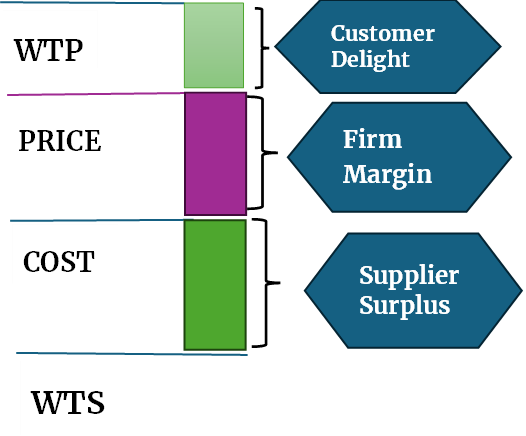
                • Increasing customers’ willingness to pay (WTP).
                • Decreasing employees’ and suppliers’ willingness to sell (WTS).
                  business-value

                  Figure 1- The Value Stick. Source: Adapted from Harvard Business School Online (Heinrich, 2026)

                  Strategic value creation relies on expanding the gap between what a customer values and what suppliers or employees require. Four main elements define this balance:

                  • Willingness to Pay (WTP). The highest amount a customer will spend for a product or service. Increasing WTP means making the product more appealing through quality, brand, or features. WTP is not fixed.
                  • Price. The actual amount the customer pays to buy the item. The gap between price and WTP is the “consumer surplus.”
                  • Cost. The total expense a company incurs to produce the good or service.
                  • Willingness to Sell (WTS). The lowest amount suppliers or employees will accept to provide raw materials or labour. Decreasing WTS through strong partnerships or efficient operations expands total business value.

                    Main Factors Causing WTP to Vary

                    Willingness to Pay (WTP) varies among customers because people perceive value, face different financial constraints, and have unique alternatives.

                    • Perceived value. Buyers place a higher ceiling on items that match their emotional needs, solve urgent problems, or offer superior quality.
                    • Income and budgets. Customers with higher disposable income have a higher absolute capacity and tolerance for spending.
                    • Available alternatives. WTP drops when a customer can easily find a cheaper substitute or competitor, and rises when an item is scarce or unique.
                    • Brand trust. High brand reputation and loyalty convince buyers that a product is safer or better, increasing what they will spend.
                    • Urgency and necessity. A product needed immediately (like emergency repairs or basic utilities) commands a much higher WTP than a luxury or optional item.
                    • Extrinsic and intrinsic traits. Observable factors like geography and age, together with internal traits like risk tolerance, change how individuals value an offer.

                      Willingness to Pay vs. Willingness to Sell

                      Willingness to pay (WTP) is the highest price a customer will pay for a product or service, while willingness to sell (WTS) is the lowest amount a supplier or employee will accept for materials or labour. WTP applies to customers, whereas WTS pertains to employees and suppliers. That is their main difference.

                      Both concepts form the outer boundaries of the Value Stick Framework, helping businesses understand how value is created and captured in a market.

                      Main Differences

                      • Definition. WTP measures the top ceiling of consumer demand, whereas WTS measures the bottom floor of supplier or worker compensation.
                      • Focus. WTP centres on customer-perceived value, while WTS centres on production costs, supplier minimums, or employee retention.
                      • Role in Trade.  A transaction happens only when the actual price falls between WTP and WTS (where WTP is greater than WTS). The gap creates total value, or social surplus.

                        Strategic Application

                        • Increasing WTP. Companies raise WTP by improving product quality, adding unique features, or building strong brand loyalty.
                        • Decreasing WTS. Companies optimise WTS by improving workplace satisfaction, streamlining supplier relationships, or lowering production expenses without losing quality.

                          References

                          Anderson, J. and Narus, J. (1998). Business Marketing: Understand What Customers Value. [online] Harvard Business Review. Available at: https://hbr.org/1998/11/business-marketing-understand-what-customers-value.

                          Boyles, M. (2022). How Do Businesses Create Value for Stakeholders? | HBS Online. [online] Business Insights Blog. Available at: https://online.hbs.edu/blog/post/how-do-businesses-create-value.

                          Heinrich, A. (2026). How Value Creation Applies to Your Business. [online] Harvard Business School. Available at: https://online.hbs.edu/blog/post/value-creation

                          Stobierski, T. (2022). A Beginner’s Guide to Value-Based Strategy. [online] Harvard Business School. Available at: https://online.hbs.edu/blog/post/value-based-strategy [Accessed 13 Sept. 2026].