

Entrepreneurship is widely regarded as a fundamental driver of economic growth, innovation, and job creation globally, playing a crucial role in enhancing productivity and structural change (Kritikos, 2024). As of 2026, entrepreneurship is increasingly seen as a mechanism for building resilience in an unpredictable economic landscape, with a significant shift toward AI-native businesses and sustainable, value-driven models.
The Close Connection Between Entrepreneurship and Entrepreneurs
The close connection between entrepreneurship and entrepreneurs is fundamentally that of the “actor” and the “action”. An entrepreneur is the person with the vision and drive, while entrepreneurship is the structured process of bringing that vision to life. They are interdependent; entrepreneurship cannot exist without an entrepreneur to initiate it, and an entrepreneur’s vision remains just an idea without the process of entrepreneurship.
An entrepreneur is an individual who identifies a business opportunity, takes on financial risks, and organises resources to create a new, innovative product or service, often with the goal of growth, profit, or social change. Derived from the French “entreprendre” (“to undertake“), they act as catalysts for economic growth and innovation.
According to ESMT Berlin. (2025), “becoming an entrepreneur is both a mindset and a process”, which requires curiosity, resilience, and willingness to embrace uncertainty. They refer to an entrepreneur as an agent of change, “who initiates and operates a business, bearing financial risks in the hope of profit” (ESMT Berlin, 2025).
Summary of the Close Interconnections
- Actor vs. Act. The entrepreneur is the individual who identifies opportunities, takes risks, and launches a business. Entrepreneurship is the “how”, the journey of transforming that idea into a functional, sustainable, or high-growth entity.
- The “Who” and the “What”. The entrepreneur represents the who (the leader, initiator, visionary), and entrepreneurship represents the what (the creation, organisation, management).
- Mindset vs. Methodology. An entrepreneur carries the mental traits (resilience, creativity, calculated risk-taking). Entrepreneurship is the application of these traits through methodologies like business planning, market analysis, and resource acquisition.
How They Work Together
- Spotting Opportunity. The entrepreneur identifies a gap in the market.
- Resource Mobilisation. The entrepreneur gathers capital and talent—this act is entrepreneurship.
- Risk Management. The entrepreneur takes on the financial and personal risks of a new, uncertain venture.
- Creation of Value. The process of entrepreneurship transforms that risk into an enterprise that brings new products, services, or jobs to the market.
| Feature | Entrepreneur (Actor) | Entrepreneurship (Action) |
| Focus | Individual/Person | Process/System |
| Role | The visionary leader | The act of undertaking |
| Traits | Passionate, resilient, risky | Innovative, systematic, organized |
| Goal | Achieve vision/profit | Create, grow, and manage a venture |
| Example | Jeff Bezos | Innovative, systematic, organised |
In short, the entrepreneur is the “dreamer” who turns a “maybe” into a “yes,” while entrepreneurship is the hard work of making that “yes” a profitable, lasting reality.
The Mindset of Entrepreneurs
To become an entrepreneur, it is important to understand the mindset of an entrepreneur, as it will not only help you evaluate your readiness but also help identify if you have the personality, characteristics, and skills to succeed. A mindset is regarded as the most important requirement for success in entrepreneurship.
According to Carol Dweck’s mindset theory, individuals hold beliefs about their own intelligence and abilities, which are categorised into fixed or growth mindsets. A growth mindset (believing skills can be developed through effort) fosters motivation, resilience, and higher achievement, whereas a fixed mindset (viewing traits as innate) leads to avoiding challenges. (Klein, 2016).
The main consequence of the mindset theory is that our beliefs about our abilities can shape how we think, feel, and behave in any given situation as follows (Klein, 2016).
- Fixed Mindset. People believe their intelligence, talents, and abilities are static traits that cannot change. They tend to avoid challenges, fear failure, and see effort as pointless, often resulting in lower achievement.
- Growth Mindset. People believe their abilities can be developed through dedication, effort, strategies, and support. They embrace challenges, persist in the face of setbacks, and view failure as a learning opportunity.
- Cultivation of Resilience. A crucial aspect of a growth mindset is understanding that if someone cannot do something, it is simply that they cannot do it yet, encouraging continued effort rather than giving up and attributing failures to personal shortcomings or “innate incompetence,” which can hurt mental well-being.
In other words, it is a particular way a person thinks and forms opinions. So, when we refer to an entrepreneurial mindset, we mean the way entrepreneurs think. Entrepreneurs are drawn towards entrepreneurial activities and outcomes. They seek opportunities for innovation and value creation.
The Close Link Between Entrepreneurship, Entrepreneur and Enterprise
The term enterprise is usually defined as a business. However, the perspective taken by the University of Birmingham (Bham.ac.uk., 2015) is relevant to our discussion here, as enterprise is described as “the ability to make things happen” through enterprising skills. This definition does not link the enterprise to something static like an entity or organisation, but a process resulting from being enterprising.
According to this perspective, enterprising people are known to have a set of the following skills, attributes, and behaviours that enable them to exploit ideas successfully:
| Enterprising Behaviours | Enterprising Attributes | Enterprising Skills |
| Opportunity seeking and grasping | Achievement of ambition | Creative problem solving |
| Taking initiatives to make things happen | Self-confidence and self-belief | Persuading |
| Solves problems creatively | Perseverance | Negotiation/selling |
| Reflective | High internal locus of control | Leadership |
| Taking responsibility for and ownership of things | Action orientation | Strategic thinking |
| Seeing things through | Preference of learning by doing | Holistically managing projects and situations |
| Networking effectively | Innovation | Intuitive decision making under uncertainty |
| Communicate ideas and information | Determination | Financial and business literacy |
| Using judgement to take calculated risks | Creativity | Digital know-how |
What this shows is that, though entrepreneurs are unique, they are unique because of their mindsets. However, such skills can be learned.
Motivation for Achievement
Abraham Harold Maslow, an American psychologist, created a theory of motivation that has popularly come to be known as Maslow’s Hierarchy of Needs, consisting of five stages as shown below. He stated that one must satisfy the lower basic needs before progressing on to meet the higher-level needs of growth. Once these needs have been reasonably satisfied, one can aspire to reach the highest level called “self-actualisation”.
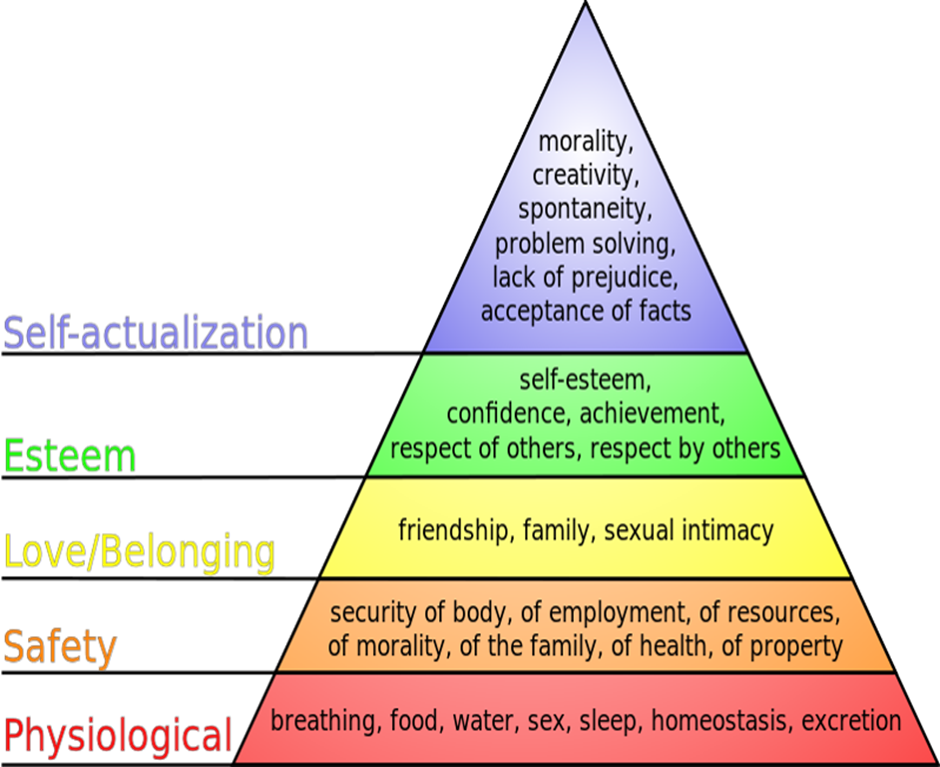
Source: Wikimedia Commons; Created by J. Finkelstein
As the diagram above shows, one of the higher-level needs is the need for achievement. Many studies identify achievement as the most important factor that motivates entrepreneurs. Research by Jari Huovinen and Matti Koiranen has shown that “A strong achievement motivation is probably the one characteristic that most clearly describes the attitudes and the behaviour of an entrepreneur (e.g. Virtanen 1996). It may also be considered as a dimension closely related to other typical characteristics for an entrepreneur, such as willingness to take risks (e.g. Littunen 2000) and growth orientation (Kirschenhofer 2006; Virtanen 1996)”.
The table below shows the close relationships between an enterprising behaviour and that of an entrepreneur.
According to an article by Dr James V Green, Director of Entrepreneurship Education, Maryland Technology Enterprise Institute, University of Maryland, the one trait that is found in all successful entrepreneurs is “need for achievement”. This need for accomplishment motivates the entrepreneur to accept challenges and the responsibility for any outcome. It can be called “drive”, “hunger” or “self-motivation”.
Dr Green states that the need for achievement is so powerful that it is the driver of success in the following ways:
- It breaks down doors. Starting a business involves uncertainty, as there are obstacles the startup will face that are difficult to predict. Investors need to be convinced that the founder and the team have the tenacity to continue the vision and learn from the challenges they encounter.
- It fuels hard work. Starting a business is a daunting task, and those who succeed are not just those with the most power or money. Success comes from continuing and not being willing to give up in the face of mounting obstacles.
- It demonstrates innovation. Investors do not invest primarily in a big idea or strategy, but more in the character of the entrepreneur. An investor needs to know whether the founding team has the tenacity to stick to its vision through all the ups and downs, and if they will learn from them. The need for achievement can lead to innovation and new, successful ideas. If entrepreneurs are too stubborn to give up, they will be forced to learn from their mistakes, adapt, and advance to succeed.
- It harnesses natural abilities. Grit, tenacity, and resilience are increasingly becoming part of talent management and are often valued more than traditional predictors of success, such as academic performance. Talent and intelligence alone are not enough as motivation for achievement is needed to focus and develop talents.
Keys to Developing a High Need for Achievement
Dr Green provides the following suggestions for developing a high need for achievement. He states that a high need for achievement makes for better entrepreneurs. “Naturally, if you have greater motivation, a greater drive, and a greater level of commitment, you’re going to have higher involvement in your job and in your career. You’re going to have higher organisational commitment and commitment to colleagues, suppliers, partners, customers, and investors. Need for achievement is, therefore, an enabler of becoming a successful entrepreneur”.
Here are the five proven techniques suggested by Dr Green for developing a high need for achievement:
- Write and Track Your Goals.
Self-monitoring is something to keep in mind as well. Do you have personal goals? Are they written? Are you tracking progress towards your goals? You must be a believer in tracking what we care about and measuring your progress towards your ambitions. Self-monitoring and milestone measuring are practices of individuals with a high need for achievement. - Reward Yourself.
Self-reinforcement is important. Do you reward yourself for your achievement? Either with incremental rewards or long-term rewards? - Be Your Own Champion.
Are you self-motivated? Or do you need others to motivate you? - Cheer for Yourself.
Do you need others to congratulate you? Or do you find satisfaction in your own success? Are you fulfilled without recognition from others? - See the Success that You Want to Achieve.
Are you the type of person who is not only driven to succeed, but you plan your own success? Do you mentally rehearse, forecast or think about future events? Do you anticipate obstacles? Do you develop alternative solutions?
So, what motivates you? Do you agree that the need for achievement is the most important factor in the motivation of entrepreneurs? Let’s have your comments!
According to the New Scientist, evidence suggests that learning to cultivate certain beliefs about your future potential is important because it can foster success and bring health benefits
The Importance and Impacts of Entrepreneurship
The key roles of entrepreneurship include:
- Job Creation. Entrepreneurs are significant job creators; in the UK, for instance, SMEs account for 99% of the business population and the majority of private sector jobs. New businesses often surge during periods of economic uncertainty when traditional hiring slows, providing essential employment opportunities.
- Innovation and Productivity. Entrepreneurs introduce new technologies, products, and processes, often challenging established firms to be more competitive and productive. By 2026, “Agentic AI” autonomous agents acting as team members are expected to be a core feature of startup operations, boosting productivity.
- Economic Resilience and Adaptation. Startups are increasingly focused on operational resilience, prioritising profitability and cash runway over rapid, unsustainable growth. In 2026, many entrepreneurs are adopting a “compliance-by-design” approach, turning regulations into strategic advantages.
- Global and Regional Impact. Entrepreneurship drives development by utilising local resources and addressing market gaps. It is a vital tool for economic development, allowing countries to diversify their economies and adopt new technology.
- Structural Changes. New ventures replace older, established firms, fostering “creative destruction,” which enhances overall economic efficiency.
Definition of Entrepreneurship
Despite the importance of entrepreneurship, there is no generally accepted definition by researchers.
Scholars broadly define entrepreneurship as the process of identifying market opportunities, innovating, and assuming risks to create value, often involving the creation of new organisations or the transformation of existing ones. Key perspectives include Schumpeter’s “creative destruction” (innovation), Kirzner’s “discovery” (opportunity), and Knight’s “risk-taking”. Definitions and Usage Examples by Authors
Definitions and Usage Examples by Authors
- Joseph Schumpeter (1934). Defined entrepreneurs as innovators who drive “creative destruction” by introducing new goods or production methods, disrupting economic equilibrium.
- Israel Kirzner (1979). Viewed entrepreneurship as a discovery process, in which individuals identify previously unnoticed profit opportunities and arbitrage them.
- Peter Drucker (1970). Focused on risk-taking, defining it as the pursuit of opportunity without regard to resources currently controlled.
- Howard Stevenson & Carlos Jarillo (1990). Described it as the process of pursuing opportunities without regard to the resources currently controlled.
- Robert Hisrich (1990). Characterised it as the initiative, creative thinking, and organisation of social/economic mechanisms to turn resources into practical accounts, while accepting risk.
- Bolton and Thompson (2000). Defined an entrepreneur as someone who habitually creates and innovates to build recognised value.
- Shane & Venkataraman (2000). Defined it as the discovery, evaluation, and exploitation of opportunities.
- Ratten (2022). Developed modern, specific definitions such as “Artisan entrepreneurship” (manual, artistic production) and “Social entrepreneurship” (using innovative resources for social change).
Common Synonyms, Core Themes and Features of Entrepreneurship.
The Centre for American Entrepreneurship (2019) defines entrepreneurship as “… the process by which individuals or a group of individuals (entrepreneurs) exploit a commercial opportunity, either by bringing a new product or process to the market, or by substantially improving an existing good, service, or method of production. This process is generally organised through a new organisation (a start-up company) but may also occur in an established small business that undergoes a significant change in product or strategy (see below on growth). It refers to an entrepreneur as “….a person who organises the means of production to engage in entrepreneurship, often under considerable uncertainty and financial risk. Entrepreneurs may partner with other entrepreneurs to jointly found companies (co-founders), or with an existing organisation (e.g., corporate or university spin-outs), or with a startup as “……a business organisation that is formed by an entrepreneur or a group of entrepreneurs, which is used to coordinate the process of entrepreneurship under a common ownership structure.” It adds that a common feature of startups is that they are temporary and focused on the process of exploiting a business opportunity and growth (Centre for American Entrepreneurship, 2019).
ESMT Berlin (2025) identifies the following main characteristics and types of entrepreneurships:
Key characteristics of entrepreneurship
- Innovation. Introducing new ideas, technologies, or ways of doing business.
- Risk Tolerance. Navigating uncertainty with resilience and adaptability.
- Opportunity Recognition. Identifying market gaps or emerging trends.
- Vision. Creating and communicating a clear sense of purpose and direction.
- Resourcefulness. Making the most of limited assets or funding.
- Autonomy and drive. Taking initiative and staying motivated without needing external direction.
- Growth orientation. Scaling ideas into long-term, sustainable ventures.
These traits often manifest differently depending on the context and personality of the entrepreneur.
Types of Entrepreneurs
Entrepreneurship is not one-size-fits-all. In practice, categories of entrepreneurs inlude the following types:
- Innovative Entrepreneurs. Focused on creating groundbreaking products or services (e.g., Elon Musk).
- Serial Entrepreneurs. Start multiple businesses over time, learning and evolving with each venture.
- Social Entrepreneurs. Prioritise social or environmental impact over profit (e.g., Muhammad Yunus).
- Lifestyle Entrepreneurs. Build businesses that support their personal goals or passions.
- Corporate Entrepreneurs (Intrapreneurs): Drive innovation and change within established organisations.
Understanding these categories helps educators and policymakers support diverse entrepreneurial journeys. However, Entrepreneurship research frequently categorises business creation into two primary types based on the motivation behind them: Opportunity (often linked to Innovative) Entrepreneurship and Necessity Entrepreneurship.
This framework, popularised by the Global Entrepreneurship Monitor (GEM), focuses on whether the entrepreneur was “pulled” into business by a promising idea or “pushed” by a lack of alternative options (Huang et al., 2023).
Opportunity (Innovative) Entrepreneurship (The “Pull” Factor)
These entrepreneurs start a business to exploit an opportunity or pursue a passion, rather than out of necessity. They are often characterised by innovation, aiming to introduce new products, services, or methods to the market.
- Motivation: Driven by a desire for independence, increased income, or the realisation of a new idea (pull).
- Characteristics: Innovative, growth-oriented, and often willing to take risks for higher returns.
- Economic Impact: Associated with increased GDP, higher innovation capacity, and job creation.
- Background: Often have other job options but choose to start a business.
Necessity Entrepreneurship (The “Push” Factor)
These entrepreneurs launch businesses because they have no other viable options for work, such as unemployment or a lack of employment opportunities.
- Motivation. Driven by the need to survive or replace lost income (push).
- Characteristics. Focused on income replacement and survival, with a lower propensity for high growth.
- Economic Impact. Provides essential livelihoods, but ventures rarely scale or create widespread employment. Often counter-cyclical, increasing during economic downturns.
- Background: Often arises from necessity due to a lack of other income options.
Key Differences at a Glance
| Feature | Opportunity/Innovative Entrepreneurship | Necessity Entrepreneurship |
| Driver | “Pull” (Better opportunities) | “Push” (Survival/Unemployment) |
| Goal | Growth & Innovation | Income Replacement |
| Risk | High (Calculated) | Lower (Due to imitation/survival) |
| Occurrence | Higher in developed economies | Higher in developing economies |
Nuance in Recent Research
- Heterogeneity: While often viewed as low-skilled, some necessity entrepreneurs show high growth aspirations, suggesting they are a heterogeneous group rather than just a homogeneous “survival” group.
- Shift in Motivation: Entrepreneurs may start out of necessity but evolve toward opportunity-driven, innovative practices as their businesses become more established.
- Hybrid Models: The distinction is not always binary; many entrepreneurs may be motivated by a combination of both push and pull factors.
According to, while many necessity entrepreneurs do not start with a new product, a segment of them still bring innovation to the market, with 35% of family-oriented entrepreneurs showing innovative traits.
Trends and Challenges to Entrepreneurship
Entrepreneurship in 2026 is driven by rapid AI integration, sustainable “green” business models, and a focus on social purpose, largely accelerated by global digitalisation. Key challenges include securing funding amid strict capital conditions, navigating high economic volatility, and overcoming intense competition through innovation and agility.
The Major Trend in Entrepreneurship
- AI and Digitalisation. Widespread adoption of artificial intelligence for workflow automation, improved customer experience, and increased efficiency, particularly for startups.
- Sustainability and Purpose. Growing focus on environmental, social, and governance (ESG) factors, with consumers prioritising eco-friendly and socially responsible companies.
- Remote and Hybrid Teams. Transitioning away from traditional setups, fostering global talent recruitment, but requiring better remote management.
- Social Entrepreneurship. Rise of businesses addressing societal problems alongside profit goals.
- Niche Marketing. Leveraging data analytics to target specific, specialised markets rather than broad audiences.
Main Challenges for Entrepreneurs
- Access to Capital. Securing funding is challenging due to reduced venture capital availability and tighter lender scrutiny.
- Economic Volatility. Rising costs of materials and labour, alongside inflation, make financial management complex.
- Talent Acquisition and Retention. Intense competition for skilled employees who are demanding flexible, innovative work cultures.
- Regulatory Compliance. Navigating increasingly complex legal environments, especially regarding data privacy and sustainability standards.
- Burnout and Resilience. Maintaining mental health and professional/personal balance during high-stress scaling phases.
- Geo-political Instability. Geopolitical instability (GPR), including conflict, trade wars, and sanctions, acts as a major constraint on entrepreneurship by escalating costs, hindering investment, and disrupting supply chains. According to a survey by EY, ECOs broadly agree that the shape of the global economy is shifting, with localisation, producing goods in the country where they will be sold, and regionalisation, creating regional supply chains to serve a particular block, is gaining more preference (Popoola, 2025). Entrepreneurs must prioritise agility, localising supply chains, and leveraging technology to survive.
Strategies for Success
- Embrace Technology. Utilising AI tools to cut costs and enhance productivity.
- Build a Strong Digital Presence. Maintaining an adaptive digital marketing strategy to remain visible.
- Focus on Sustainability. Aligning business models with ESG goals to attract investors and consumers. Aligning business models with ESG (Environmental, Social, and Governance) goals involves integrating sustainability directly into core strategies rather than treating it as separate initiatives.
- Develop Strategic Partnerships. Network and collaborate to share risks and resources.
- Pivoting. Staying adaptable to change by embracing, not avoiding, market pivots when necessary.
By leveraging AI and focusing on efficiency, entrepreneurs are navigating a high-volatility environment to deliver growth. References