

Entrepreneurship is the process of designing and launching a new business venture while assuming the primary financial risks in pursuit of profit or social impact. It is distinct from traditional employment or standard business ownership due to its core focus on relentless innovation, market disruption, and scalability.
What truly sets entrepreneurship apart is how it redefines value creation, risk management, and work management.
Intrapreneurship vs. Entrepreneurship
Intrapreneurship is the practice of acting like an entrepreneur within a large organisation. It empowers employees to innovate, take risks, and develop new products or services using the company’s resources. Unlike entrepreneurs, intrapreneurs enjoy financial stability and corporate backing while driving bottom-up innovation.
Main Features
Notable examples of Intrapreneurship include the famous “20% Google rule” (allowing employees to spend time on personal projects), which led to the development of Gmail and Google Maps. Also, Amazon: Small, agile “two-pizza teams” led to the development of Amazon Prime, and Post-it Notes, a ubiquitous office staple, were developed by a 3M scientist during his personal project time
Main Traits of an Intrapreneur
Intrapreneurs share key characteristics with traditional entrepreneurs, including:
To build a culture of intrapreneurship, organisations often implement specific frameworks:
The main differences between the two come down to risk, resources, autonomy, and the reward structure:
The Main Differences at a Glance
| Feature | Entrepreneurship | Intrapreneurship |
| Context | Founds a new organization or startup. | Innovates within an existing, established company. |
| Risk Factor | High personal financial and career risk. | Low to moderate risk; salary and job security remain stable. |
| Resources | Must source all funding, data, talent, and brand capital from scratch. | Leverages the company’s existing budget, brand, and infrastructure. |
| Autonomy | Complete control over strategy, direction, and daily operations. | Must operate within corporate guidelines and secure executive buy-in. |
| Rewards | Retains equity and direct profits from the business. | Rewarded through promotions, bonuses, or internal recognition. |
Table 1- Main Differences Between Intrapreneurship and Entrepreneurship: Source – Fredin, S., & Lidén, A. (2020). Entrepreneurial ecosystems
Why the Distinction Matters
The distinction matters because entrepreneurs are typically the ones who develop new markets or entirely disruptive product concepts and take full ownership, but face an uphill battle to secure early-stage funding and establish market presence. On the other hand, intrapreneurs typically focus on incremental innovations, new product lines, or improving internal processes within the corporate umbrella. Classic examples include an employee championing a new software tool that drastically improves team productivity, or a team designing a brand-new spin-off product backed by a larger corporation (like the creation of the Sony PlayStation or Google News).
The Main Characteristics of Entrepreneurship
The main characteristics of entrepreneurship include a willingness to take calculated risks, innovation, and a passion-driven, resilient mindset. Entrepreneurs are self-motivated, proactive, and persistent in identifying market opportunities and overcoming obstacles to create value (ESMT Berlin, 2025).
Systems Thinking and Entrepreneurship
Systems thinking in entrepreneurship is the practice of viewing a startup or business as an interconnected set of components rather than isolated departments. It shifts a founder’s focus from reactive problem-solving to proactively understanding how products, operations, and markets dynamically interact, enabling sustainable growth and innovation.
Why Founders Need Systems Thinking
Main Areas to Apply Systems Thinking
- Business Model Design. Instead of just building a product, founders design the whole “engine.” This involves mapping out how value is created, how it is delivered to the customer, and how the business captures revenue.
- The Customer Journey. A customer’s experience is a system spanning marketing, the sales pipeline, product onboarding, and customer support. Treating this as a singular ecosystem ensures that a glitch in support doesn’t negate good marketing.
- Innovation and Ecosystems. Entrepreneurs operate within larger market, regulatory, and environmental ecosystems. Social entrepreneurs, for example, use systems thinking to evaluate the broader economic and institutional impact of their innovations.
How to Build a Systems-Thinking Mindset
Entrepreneurship as a Complex Adaptive System
Entrepreneurship operates as a Complex Adaptive System (CAS) because it comprises diverse, interconnected agents (entrepreneurs, investors, customers) who continually interact, learn, and evolve in response to unpredictable market changes. Rather than following linear, predictable paths, the system relies on continuous adaptation, self-organisation, and emergent outcomes.
Viewing entrepreneurship through this complexity lens highlights several key characteristics (Han et al., 2019):
Understanding entrepreneurship as a CAS is critical for modern founders and policymakers. Rather than enforcing rigid, bureaucratic structures, the most resilient environments, such as the regional innovation hub, Zhongguancun EE, in China. Zhongguancun, located in Beijing’s Haidian District, is widely known as “China’s Silicon Valley”. As China’s first national high-tech zone, this leading entrepreneurship ecosystem (EE) is the epicentre of the country’s information technology, AI, and startup industries, situated among prestigious institutions like Tsinghua University. In business and economics, an Entrepreneurship Ecosystem (EE) describes the network of interconnected individuals, institutions, and startups. The Zhongguancun EE is one of the most viable and rapidly developing entrepreneurial environments in the world. Viewing entrepreneurship through the lens of complexity science, specifically as a Complex Adaptive System (CAS), reveals several key dynamics
Emergence Over Planning
Complex systems do not dictate outcomes from the top down; they “emerge” from bottom-up interactions. Similarly, successful startups rarely survive their original, rigid business plans. Instead, value and growth emerge organically as founders continually test, learn, and adapt their products, based on market feedback.
Entrepreneurial Ecosystems
Entrepreneurship does not happen in a vacuum. It relies on the local and global Entrepreneurial Ecosystem (EE). These networks, comprising founders, investors, universities, mentors, and government agencies, interact dynamically. The health of a startup is directly tied to how well it navigates and leverages the resources, knowledge, and relationships within this larger system.
Non-Linearity and the Butterfly Effect
In a complex system, small inputs can produce wildly disproportionate, unpredictable outputs. For an entrepreneur, this means a minor, localised pivot in their product features or a seemingly insignificant viral social media post can trigger explosive, exponential business growth.
Co-evolution and Adaptation
Startups survive by co-evolving with their environments. As a venture introduces new technologies or business models, it shifts the market, forcing competitors and customers to adapt. This continuous feedback loop demands that entrepreneurs remain highly flexible rather than using static operating models.
Managing Chaos and Resilience
Complex systems hover at the edge of chaos to allow for rapid innovation. Enterprises face tight interdependencies (such as global supply chains, digital platforms, and shifting financial markets), which can amplify disruptions. Building resilience within this complexity requires systems thinking, allowing businesses to self-organise and bounce back from systemic shocks.
Understanding business through this complexity-based framework enables founders to focus on building adaptable, responsive organisations rather than attempting to control every variable.
The Role of Entrepreneurial Ecosystems
The OECD defines the entrepreneurial ecosystems as “……….a set of entrepreneurial actors (both potential and existing), entrepreneurial organisations (e.g. firms, venture capitalists, business angels, banks), institutions (universities, public sector agencies, financial bodies) and entrepreneurial processes that come together and interact to create the conditions in which new businesses are created and grow” (OECD, 2024). Fredin & Lidén, 2020), define it as “A set of interdependent actors and factors coordinated in such a way that they enable productive entrepreneurship within a particular territory.” (p. 1).
So, an entrepreneurial ecosystem is a geographical interconnected network of actors, such as founders, investors, universities, and policymakers, that interact to support the creation and growth of new businesses. It provides the vital resources, knowledge, and infrastructure for startups to scale.
A thriving entrepreneurial ecosystem relies on a combination of specific elements that foster innovation and business growth.
Main Components of an Ecosystem
Why It Matters
Rather than operating in isolation, a successful entrepreneur depends on the environment around them to succeed. When these factors work together harmoniously, they create a self-sustaining cycle where successful founders become mentors and investors for the next generation of startups.
For example, regional hubs like the London-Gravesend corridor or Silicon Valley are considered strong ecosystems because they combine top-tier talent, localised funding, and a highly networked community. You can explore how local and global networks operate by visiting the Global Entrepreneurship Network or reviewing entrepreneurship research provided by the OECD Entrepreneurial Ecosystems program.
The Evolution of the Concept of Entrepreneurial Ecosystems

The label, entrepreneurial ecosystems, feels modern because globalisation and digital transformation have changed how these ecosystems function. While older models focused on physical proximity to universities and traditional industries, modern ecosystems heavily incorporate virtual networking, global capital, and rapid cross-border knowledge exchange, removing the geographical or localised element.
While the term gained immense popularity in the 2010s with the rise of tech hubs, the core concept of the “entrepreneurial ecosystem” is not entirely new. The foundational ideas emerged in the 1980s and 1990s as a shift away from studying isolated founders toward viewing entrepreneurship as a broader, community-wide phenomenon.
Table 1: List of Components in EE. Source:
| List of Components in EE | ||
| Domains of an EE | Components | Examples |
| Conducive culture | Tolerance of risk, mistakes, failures; ambition; international reputation; visible success stories; attitudes; | Fredin & Lidén, (2020) |
| Enabling policies and leadership | Research institutes; venture-friendly legislation; regulatory framework incentives; financial support; social legitimacy; entrepreneurship strategy; | Fredin & Lidén, (2020) |
| Availability of appropriate finance | Micro-loans; angel investors, friends and family; zero-stage venture capital; venture capital funds; private equity; public capital markets; debt; | Fredin & Lidén, (2020) |
| Quality human capital | Skilled and unskilled; serial entrepreneurs; later generation family; specific entrepreneurship training; general degrees (professional and academics); mentors and dealmakers; | Fredin & Lidén, (2020) |
| Venture-friendly markets for products | Multinational corporations; diaspora networks; distribution channels; reference customers; early adopters for proof-of-concept; local market; | Fredin & Lidén, (2020) |
| A range of institutional supports | Accounting; investment bankers; technical experts, advisors; telecommunications; energy; transportation and logistics; university; patent lawyers. | Fredin & Lidén, (2020) |
Table 1: List of Components in EE. Source: Fredin, S., & Lidén, A. (2020). Entrepreneurial ecosystems: towards a systemic approach to entrepreneurship? Geografisk Tidsskrift-Danish Journal of Geography, 120(2), 87–97. https://doi.org/10.1080/00167223.2020.1769491
Entrepreneurs stand out for their distinct mindset and behavioural traits, driven by a high tolerance for ambiguity, an obsession with problem-solving, and a deep-seated need for autonomy. While most people prioritise job security and predictable routines, entrepreneurs are willing to embrace uncertainty to build something entirely new.
The key psychological and practical traits that separate entrepreneurs from the general population include:
The Entrepreneurial Innovation Ecosystem
An entrepreneurial innovation ecosystem is an interconnected, geographic or virtual network of startups, research institutions, governments, and investors. It is a collaborative hub where entrepreneurs access capital, mentorship, and technology to transform novel ideas into scalable, market-ready solutions.
While the two terms are often used interchangeably, they have distinct focuses. Innovation ecosystems focus on value creation. They develop novel technologies, new knowledge, and solve complex problems through community collaboration. Entrepreneurial Ecosystems focuses on entrepreneurship development. They are bottom-up, community-driven environments that help individual founders scale their ventures, access resources, and navigate the market.
The Main Stakeholders
A thriving ecosystem relies on a symbiotic relationship between key players, often called the “Triple Helix”:
Why Ecosystems Matter
To explore or engage with local startup and innovation networks in your region, you can utilise community-driven directories like Crunchbase to track investments, or find active UK-based incubators and accelerators through resources like the UK Tech Cluster Group.
The Innovation Ecosystem
An innovation ecosystem is a collaborative network of diverse stakeholders—including researchers, entrepreneurs, investors, corporations, and governments—interacting to foster, support, and accelerate the development of new technologies and businesses. These systems combine resources, expertise, and infrastructure to drive economic growth and address complex challenges in a given region.
The International Development Innovation Alliance (IDIA) defines it as consisting of “……..enabling policies and regulations, accessibility of finance, informed human capital, supportive research, markets, energy, transport and communication infrastructure, a culture supportive of innovation and entrepreneurship, and networking assets, which together support productive relationships between different actors and other parts of the ecosystem” (International Development Innovation Alliance, n.d.).
Main Components and Characteristics
According to the MIT Sloan School of Management, Innovation Ecosystems are typically urban, with populations in millions. They have no traditional political boundaries and include research institutions or hubs. support for innovative activities. Their main components are summarised below:
Examples and Initiatives are the European Innovation Ecosystems (EIE): A Horizon Europe programme aimed at creating more connected, inclusive, and efficient innovation systems across Europe and the UK Health Innovation, which is an initiative aimed at bringing together the NHS, academia, and industry to accelerate the adoption of new healthcare technologies.
Benefits
The Difference Between Starting a Business and Entrepreneurship
Starting a business is often equated with entrepreneurship. So, what is entrepreneurship?
Several theories help to define entrepreneurship. Joseph Alois Schumpeter, an Austrian economist, is well known for his pioneering work on entrepreneurship. In his work “The Theory of Economic Development”, he states that entrepreneurship drives economic growth, as it enhances the use of means of production in a society in a more current and more efficient way, and in combinations. Other research has confirmed that countries with a higher level of entrepreneurship also have higher levels of innovation and technological change. Research by Daniel Smith, “The Role of Entrepreneurship in Economic Growth”, also confirms that entrepreneurship has a significant impact on economic growth (Smith, 2010).
There are many definitions of entrepreneurship. However, Schumpeter defined entrepreneurship as innovation, involving new means of production, new products, and new forms of organisation. These innovations cause creative destruction by making old inventories, ideas, technologies, skills, and equipment obsolete. He was of the view that this creative destruction causes continuous progress and improves the standards of living for everyone. Another important study which followed this view is the work of Professor Israel Kirzner. He views that alertness to opportunity is the fundamental quality of the entrepreneur. Alertness is defined as the entrepreneur’s ability to perceive new economic opportunities, and this alertness must necessarily precede actions to exploit the opportunities.
Another definition that helps to explain what entrepreneurship is, which describes what entrepreneurs do, is the definition by Professor Howard Stevenson, the Sarofim-Rock Baker Foundation Professor Emeritus at Harvard University. He states that “Entrepreneurship is the process by which individuals pursue opportunities without regard to the resources they currently control”. The three keywords in the definition are “pursuit”, “opportunity” and “without regard to resources controlled”. The three keywords are briefly explained below:
Pursuit
This refers to the single-minded and relentless focus the entrepreneurs display. According to conventional wisdom, opportunities do not wait for anyone; entrepreneurs perceive that opportunities will be available for a short time. With limited resources, they have to work with what they have; they perceive the urgency for tangible progress to attract resources. This is not the case in established companies where resources are already available, and opportunities are grouped into portfolios.
Opportunity
This refers to something novel that will create one or more of the following values:
- Creation of a truly innovative product
- Developing a new business model
- Improving an existing product or service by making it cheaper or better.
- Creating new customers for existing products
Without Regard to Resources Controlled.
This refers to constraints on resources. Most entrepreneurs have limited resources and must bootstrap and invest their personal money in the start-up until it is operational and begins to generate revenue. In some cases, the founders will have to look for resources beyond their control.
Many definitions of entrepreneurship have traditionally linked it with risk. In reality, entrepreneurs come in many forms, and they are not people who go out looking for risks. There are no human beings like that. According to Professor Eisenmann, the risks associated with entrepreneurship result from pursuing novel opportunities without adequate resources. These risks can be divided into four types (Ojomo, 2024) :
- Demand risk: the risk that there may not be potential customers for the product or service.
- Technology risk: situations where an engineering or scientific breakthrough is required to establish the product or service.
- Execution risk: the ability to attract staff and partners with adequate skills to execute the venture.
- Financing risk: the likelihood of acquiring sufficient finance to execute the venture.
From the above, it can be seen that certain factors have stood out that commonly describe what entrepreneurs do. According to Dr Julie Holland, Director, Glendonbrook Centre for Enterprise Education, Loughborough University, these are “alertness”, “opportunity”, “creative skills” and “action”. This can be illustrated graphically as below:
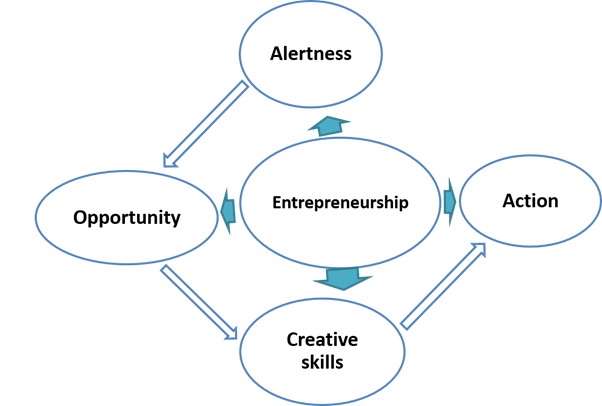
Figure 1: Illustration of the Four Main Entrepreneurial Skills. Source: Holland, J. (2015). Innovation and Enterprise. Glendonbrook Centre for Enterprise Education, Loughborough University
We can see from the above that entrepreneurs are very good at recognising opportunities. This does not happen automatically; they listen, follow and study what is going on in the industry. This is their passion. They also take action, as the saying goes, “no risk, no gain”. The other thing is that they have creative skills that enable them to be successful, and we will discuss this when we examine the entrepreneurial mindset.
References
AL-Ajlouni, M.M. (2023). The role of entrepreneurship on the economic growth and development. Academy of Entrepreneurship Journal, 29(S3), 1-10.
Budden, P. and Murray, F.E. (2025). What is an innovation ecosystem? [online] MIT Sloan School of Management. Available at: https://mitsloan.mit.edu/ideas-made-to-matter/what-innovation-ecosystem [Accessed 18 May 2026].
Eisenmann, T (2013). Entrepreneurship: A Working Definition. [online] Website name. Available at: https://hbr.org/2013/01/what-is-entrepreneurship [Accessed 05 Jan. 2018].
ESMT Berlin (2025). What is entrepreneurship? Definition, concept & examples. [online] Available at: https://esmt.berlin/knowledge/what-is-entrepreneurship.
Gartner, William & Teague, Bruce & Baker, Ted & Wadhwani, R.. (2017). A brief history of the idea of opportunity. 10.4337/9781783475445.00007.
Fredin, S., & Lidén, A. (2020). Entrepreneurial ecosystems: towards a systemic approach to entrepreneurship? Geografisk Tidsskrift-Danish Journal of Geography, 120(2), 87–97. https://doi.org/10.1080/00167223.2020.1769491
Han, J., Ruan, Y., Wang, Y. and Zhou, H. (2019). Toward a complex adaptive system: The case of the Zhongguancun entrepreneurship ecosystem. Journal of Business Research. Doi: https://doi.org/10.1016/j.jbusres.2019.11.077.
Holland, J. (2015) Innovation and Enterprise.
Ilahi, Saud & Alshehri, Abdullah. (2020). The Role of Entrepreneurship in Spurring Economic Growth. 9. 122-131.
International Development Innovation Alliance (n.d.). What is an Innovation Ecosystem? [online] International Development Innovation Alliance. Available at: https://www.idiainnovation.org/what-is-an-innovation-ecosystem.
OECD. (2024). Entrepreneurial Ecosystems. [online] Available at: https://www.oecd.org/en/about/programmes/entrepreneurial-ecosystems.html.
Ojomo, E. (2024). The job of entrepreneurs is to manage these four risks. [online] Clayton Christensen Institute. Available at: https://www.christenseninstitute.org/blog/the-job-of-entrepreneurs-is-to-manage-these-four-risks/#:~:text=Eisenmann%20goes%20on%20to%20describe,execution%20risk%20and%20financing%20risk. [Accessed 19 May 2026].
Schumpeter, J. A. (1934). The Theory of Economic Development: An Inquiry Into Profits, Capital, Credit, Interest, and the Business Cycle. Transaction Publishers. Google Books
Smith, Daniel (2010) “The Role of Entrepreneurship in Economic Growth,” Undergraduate Economic Review: Vol. 6: Iss.1, Article 7. Available at: http://digitalcommons.iwu.edu/uer/vol6/iss1/7
Stam, E., & Spigel, B. (2017). Entrepreneurial ecosystems. In R. Blackburn, D. DeClerk, & J. Heinonen (Eds.), Sage Handbook for Entrepreneurship and Small Business. Sage Publications. Retrieved from https://dspace.library.uu.nl/bitstream/handle/1874/347982/16_13.pdf?sequence=1&isAllowed=y(open in a new window)